(Note: Below each video, I’ve highlighted useful tips for the making and sharing of our art.)
Reading from The Memory Room
Reading at Pegasus Books, Berkeley, CA with Lip Service West
WE CAN SHARE HOW AUTOBIOGRAPHICAL OUR NOVEL IS
00-7:47 Reading
-Barbara gives a lecture to her therapist titled, “What Every Buried Child Knows”
-Why dirt is not one thing
-Every child seeks a moral order and creates one when it cannot be found
Reading at Prairie Lights, University of Iowa (Audio)
“Live From Prairie Lights.” (Audio) Reading by Mary Rakow, Q & A with Julie Englander.
University of Iowa; November 18, 2002
WSUI 910 AM. The Writing University and Digital Research & Publishing, University of Iowa.
Listen to the interview: Mary Rakow — Live From Prairie Lights
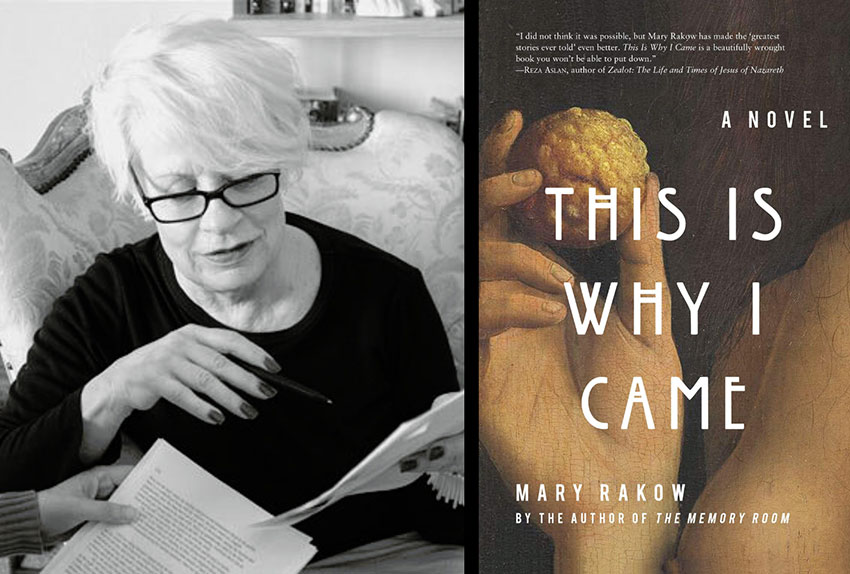
Reading From This Is Why I Came
I started every reading talking about my method. This novel explores iconic stories in the Bible, one of the most ancient texts on the planet. A book about which people have strong and mixed feelings. But the stories have been salvific for me since childhood, dealing with issues I explored in my first novel, The Memory Room.
The Bible, like all great art, is mostly emptiness. We go into that emptiness with ourselves, coming up with our own answers to questions the blank spaces give rise to in us. Why was Jonah angry? Why wasn’t Joseph at the Crucifixion? What did Zaccheus do for the rest of his life? We write from our own distinct perception of the world producing, over time, the story only we can write. And when we do this, we don’t just make stuff. We make art. Let’s help each other do exactly that.
Reading: The Jesus and John Chapters
3:30 This book is a safe place
KNOW YOUR PRE-SUPPOSITIONS
12:30 Everybody hungers. Even God.
12:40 I don’t think God is gendered
STAND BY YOUR WORK. READ IN FRONT OF OTHERS
14:14-25:00 Reading
KNOW EACH OTHER’S WORK BY HEART
25:35 Convo with David Francis
34:00 The importance of paradox
37:00 Fiction has no limits
CLING TO WHAT INSPIRES YOU
39:00 Visual art in my writing process
LEARN NEW THINGS AFTER YOUR BOOK COMES OUT
1:00:00 “Lectio Divina” a medieval way to read. Who knew?
Reading: The Noah Chapter
1:37 Intros by publisher Jack Shoemaker
EXPLAIN YOUR METHOD
3:13 What backstory would make this event make sense?
KNOW WHAT SAVED YOU
4:17 Bible stories in childhood. “I was Noah”
DEDICATE YOUR READING
5:50 To Coptic Christians massacred yesterday
START WITH YOUR PREMISE
8:25 The Bible as emptiness
10:29-30:00 Reading
13:26 Noah felt the anger of God
17:00 A dog swam in the current
28:45 God said to Noah, “You made me anew.”
LEARN FROM A LIKE-MINDED STRANGER
30:00 Convo with Rev. Liz Tichenor
42:00 A sacred text invites relationship
59:00 Paradox is like Palmolive Dish Soap & Hypostatic Union
1:06:00 My pivot into the contemplative life
Reading: The Abraham and Isaac Chapters
0:31 Intros by Scott Wood
3:55 What I care about
4:55 Dedicating the reading to Farkhunda Malikzada
READ A SEQUENCE OF CHAPTERS
8:00-20:00 Reading
17:00 The hunger for innocence in an adult is the most dangerous hunger
CONVERSE WITH A WRITER WHO CARES FOR YOUR SUBJECT
20:00 Convo with David Francis
20:00 Bible characters didn’t know how their story would end
27:30-31:00 The flannel board in Sunday school
33:00 Suggesting a method. Not what I came up with
LET YOURSELF DIGRESS
50:00 The Bible’s Book of Leviticus like God on speed. But it’s about love
53:00 We can imagine a moral order. We get used to this. Like light bulbs
Reading: The Zaccheus Chapter
0:40 Remarks by Co-host’s Josh Miller, Susan Bernard & Janet Fitch
0:17 The original Zaccheus story
SHARE YOUR QUESTION
17:45 What did Zaccheus do for the rest of his life?
21:00-39:15 Reading
23:15 Jesus said, “You can stop feeling like a failure at love.”
26:15 “When Jesus touched me I felt pure-hearted.”
41:00 Convo with David Francis
42:35 What drew you to Bible stories?
47:45 Always looking for a stronger truth
LET YOURSELF DIGRESS
55:17 (re: Eve) “Of course she moved toward the serpent!”
59:50 (re: Jesus at Cana) “But he’d never done a miracle before!”
SEE HOW A READER COMPLETES YOUR WORK
1:06:40 She gave “cloistered communities” a whole new meaning
1:09:20 We make art hoping such moments will occur
Reading: The Jonah Chapters
3:25 Why read Jonah at Prairie Lights Books?
4:35 Dedication: the tomb of the Prophet Jonah in Mozul
bombed to oblivion July 25, 2014
QUESTION ICONIC THINGS
4:35 Jonah’s story in the Bible
7:25 The weird things about it
9:40 What backstory would make this make sense?
12:20-35:24 Reading (It’s not about the whale)
23:10 Jonah raged against God
28:31 He tells his wife, “I wanted a better God.”
BRING AN ANCIENT CHARACTER INTO THE 21st CENTURY
32:00 Jonah tells her “To doubt the God you believe in is to serve Him.”
PAY ATTENTION TO WHATEVER GIVES YOU PEAK ENGAGEMENT
35:31 Visual Art in my process. Picasso’s “Return of the Harlequin”
42:00 There is no “high” and “low”
42:30 Don’t say, “I’ve got to love opera!”
42:46 Any form of engagement can be sacred
Reading: The Nativity Chapters (audio only)
0:50 Why does Joseph disappear after Jesus is 12? Why wasn’t Joseph at the Crucifixion? The Resurrection?
3:20 The Orthodox icon of Nativity offers answers
5:00 Defining terms: Annunciation, Visitation, etc.
STATE YOUR BASIC ASSUMPTIONS
7:14 Viewing Jesus, Mary & Joseph through the lens of the infanticide
8:45 People in the Bible were just like us
9:00-37:00 Reading The Nativity Chapters
21:40 Joseph and Mary flew out of the familiar into the great unknown
25:44 Whenever the calculating came to Joseph
32:00 The Dormition of Mary
35:30 The Great Hymn of the Ordinary
CONVERSE WITH A WRITER INFLUENCED BY MUSIC
37:37 Convo with David Landau
WORK UNTIL YOU GET IT RIGHT
38:40 Motherwell’s “Elegy to the Spanish Republic”
A REMARK THAT ENDED MY 12 YEARS OF FAILURE
42:00 Garth Greenwell’s observation that rescued me
45:00 The Bible’s sturdiness
53:45 Why I love The Gideon Bible!
Fireside Podcast: New Words, with Mary Rakow (9/13/2021)
“I think the best art always asks questions that it can’t actually answer.”
— Mary Rakow
Listen to the Podcast here
Interviews
The Memory Room
“…abiding questions, big picture questions…”
Mary Rakow and The Memory Room, an Interview with Sam Dunn
“I did not set out to write a novel that was unusual in form.”
Interview in LA Times with Susan Salter Reynolds
“A friend said, ‘Dig a hole and put a plant in it and you’ll feel better’.”
Author Mary Rakow on How Spirituality and Gardening Influenced Her Life by Victoria Clayton
Martínez Celaya, Working Methods
[TBD]
This Is Why I Came
“I felt so close to Adam…totally unable to make what he wanted to make.”
An Interview with Mary Rakow by Cara Benson, Book Slut, 2026
“I think of Christianity, Judaism, all religions as a dream…”
The Bible According to Dr. Mary, by Nancy Spiller,Los Angeles Review of Books (LARB)
“I think we want something more existential…”
Interview with Mary Rakow in New In Books
Editing as an Urban Hermit
“I feel great satisfaction when I’ve helped someone make art.”
Rakow Interview with Jane R., 2026